
Choosing a Donation Platform for Your Nonprofit
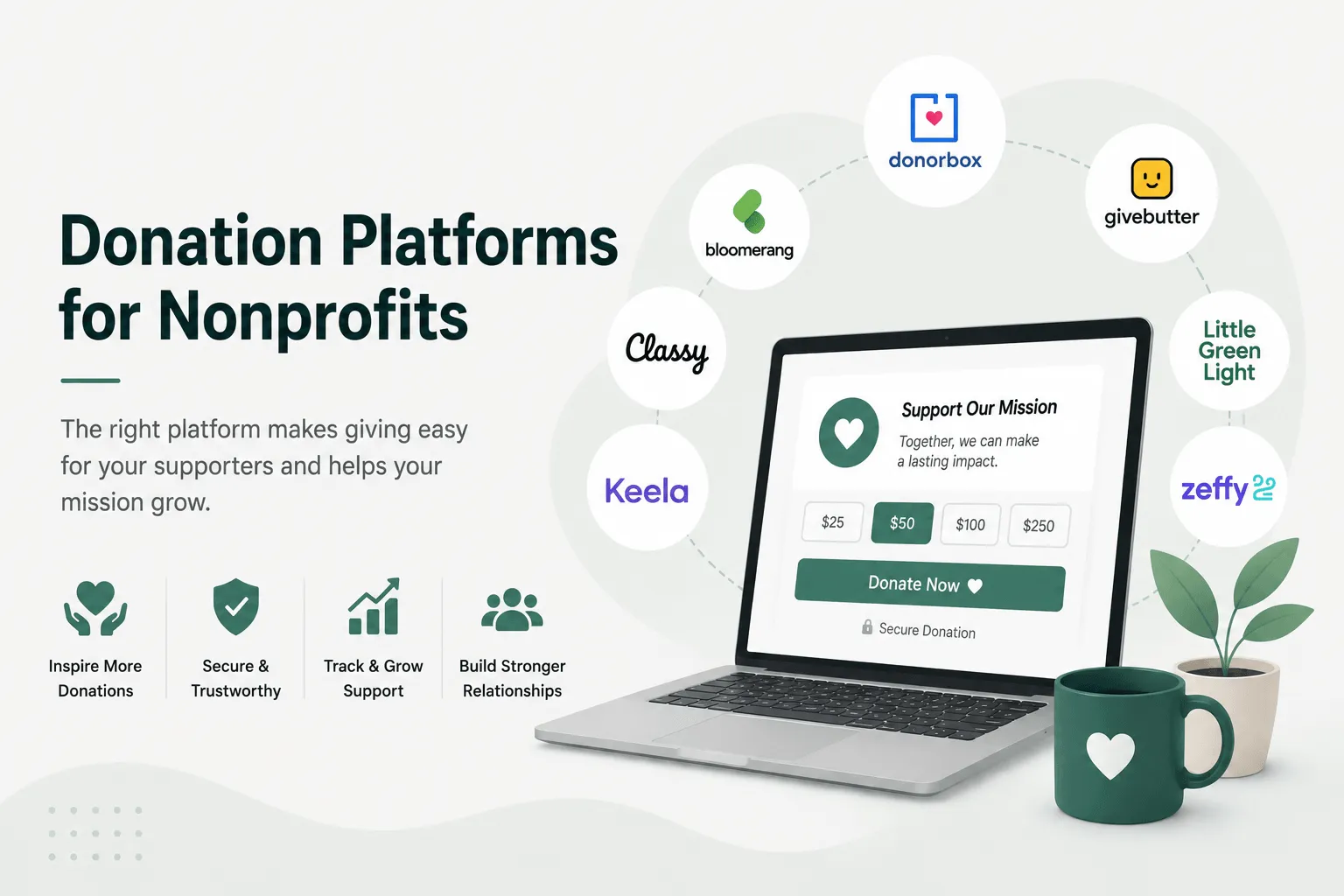
Most organizations pick a donation platform once and live with it for a decade. It ends up holding the donor list, the giving history, the recurring gifts and the receipts — which makes it one of the hardest systems to change your mind about later.
That is the thing to optimize for. Not the feature list.
Start with what you actually need
The market splits into three shapes, and a lot of wasted money comes from buying the wrong one.
A donation form. You need to take money online, issue a receipt, and support recurring gifts. Your donor list is small enough to live in a spreadsheet or a light CRM. Most organizations under a few hundred donors are here, and they are frequently sold something much larger.
A donor CRM with giving attached. You are running appeals, segmenting, tracking soft credits and pledges, and you need giving history to sit next to relationship history. This is the middle of the market and where most growing nonprofits land.
An enterprise fundraising suite. Multiple entities or chapters, planned giving, grants, events, complex finance integration, and a fundraising team big enough to have specialists. Genuinely necessary at scale, ruinously heavy below it.
The questions that actually decide it
Fee structure, first. There are three layers and vendors present them inconsistently:
- Payment processing — typically around 2.2–3% plus a fixed amount per transaction, going to Stripe or PayPal, not the platform.
- Platform fee — the vendor’s own cut, anywhere from zero to several percent.
- Subscription — a monthly or annual license, sometimes instead of a platform fee, sometimes as well as.
A “free” platform usually means no subscription and no platform fee, funded by asking donors to cover costs at checkout. That works, and it also means a portion of your donors are being asked to pay a fee you chose. Whether that is a good trade depends on your donors, not on the maths.
Then the questions people forget until it is too late:
- Can you export everything, including recurring gift subscriptions? Contacts and history export from nearly everywhere. Active recurring donations often do not — they live with the payment processor, tied to the platform’s account. If they cannot move, changing platforms means asking every monthly donor to re-enter their card, and you will lose some of them. Ask this before you sign.
- Whose Stripe account is it? A platform-owned merchant account is convenient and makes leaving harder. Your own connected account is better.
- What is the contract term? Month-to-month, annual, or multi-year with auto-renewal. Enterprise fundraising software commonly runs multi-year with a notice window that is easy to miss.
- Is there an implementation fee? At the top of the market these can exceed the first year’s license.
- Does it handle your receipting rules? US 501(c)(3) acknowledgment requirements and Canadian CRA receipt rules are not the same thing, and not every platform does both properly.
- Does the embed fit your site, or take it over? Some forms are a clean embed. Others send donors to a vendor-branded page mid-transaction, which costs conversions.
The main options
Fair warning: pricing and ownership in this sector change constantly. Several of these platforms have been acquired in the last two years. Check current terms directly.
| Platform | Shape | Notes |
|---|---|---|
| Donorbox | Donation form + light CRM | Quick to launch, clean embeds, strong recurring giving. Platform fee on the free tier, subscription tiers reduce it. |
| Givebutter | Forms, events, peer-to-peer | No subscription; funded by optional donor tips. Strong for campaigns and events. |
| Zeffy | Donation form | No platform fee at all, funded entirely by donor tips. Genuinely free; the trade is the tip prompt on every transaction. |
| Keela | Donor CRM | Solid mid-market CRM with good segmentation and automation. Now part of Aplos, alongside Raisely, under the Velora umbrella after 2024–25 consolidation. |
| Bloomerang | Donor CRM | Built around donor retention reporting. Popular with small and mid-sized US organizations. |
| DonorPerfect | Donor CRM | Long-established, deep, less modern. Strong on complex gift types. |
| Little Green Light | Donor CRM | Inexpensive, capable, deliberately unfashionable. Often the right answer and rarely the one that gets pitched. |
| Classy | Campaign fundraising | Events and peer-to-peer at scale. Now owned by GoFundMe. |
| Bonterra | Enterprise suite | The merged EveryAction / Social Solutions / Network for Good estate. Broad, and correspondingly heavy. |
| Blackbaud | Enterprise suite | Raiser’s Edge NXT and the surrounding products. The incumbent at the top of the sector. |
| Aplos | Fund accounting + fundraising | Accounting-first, which matters if fund accounting is your real problem. |
| Stripe / PayPal direct | Payments only | Lowest fees, no fundraising features at all. Viable if you are building the rest yourself. |
About the enterprise end
Blackbaud and Bonterra dominate the top of this market, and there is a reason large organizations buy them: at real scale, with multiple entities, planned giving and finance integration, the alternatives genuinely run out of road.
The honest criticism is not that they lack features. It is the total cost of ownership. Multi-year contracts, implementation fees, per-module pricing, and a level of complexity that means the system needs someone whose job it is to run it. Organizations that buy at this tier because they expect to grow into it usually find they have bought an administrative burden instead of a capability — and by the time that is clear, the donor history is inside it and the recurring gifts are tied to it.
If you are choosing between an enterprise suite and a mid-market CRM, the useful test is whether you have a person who will own the system. If the answer is “the executive director, on top of everything else,” buy the smaller thing.
Where the website comes in
The platform is only half of it. The donation experience is a page on your site, and the things that lose gifts are usually not platform features:
- A form that takes the donor away from your site at the moment of payment.
- A page that loads slowly on a phone, which is where most first-time gifts start.
- A form asking for more than it needs. Every optional field costs completions.
- No obvious recurring option, or one buried below the fold. Monthly donors are worth several times a one-off gift, and asking well is most of it.
- A receipt email that looks like a system notification instead of a thank you.
If you are running a Google Ad Grant, this matters twice over — the grant sends traffic, and a donation page that does not convert wastes it.
Getting help
Ecropolis has built and run platforms for nonprofits, associations and national chapter networks for years, including SCORE, where 230+ local chapters operate on one system. If you are choosing a platform, migrating off one, or trying to work out why a donation page is not converting, see what we do for nonprofits and education or tell us about your organization.