
Top SEO Trends Small Businesses Should Watch
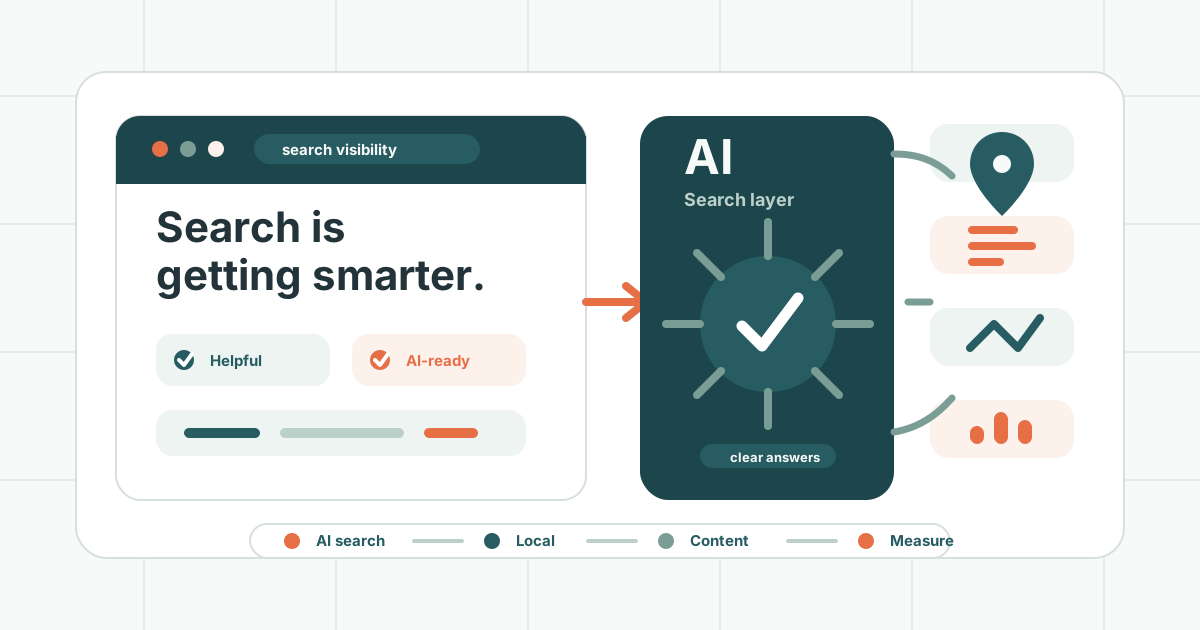
SEO is still about helping the right people find the right page.
But the way people search is changing.
Some visitors still type a few words into Google and click a familiar blue link. Others ask longer questions. Some use voice search. Some see AI-generated summaries before they ever reach a website. Some compare businesses through maps, reviews, social platforms, YouTube, Reddit, or a shopping result.
That does not mean SEO is dead.
It means small businesses need to think about search more broadly: useful content, fast pages, local credibility, accurate business information, and clear answers that can be understood by both people and search systems.
Here are the SEO trends worth paying attention to.
AI Search Is Changing the First Impression
Google’s AI features, including AI Overviews and AI Mode, can summarize information directly inside search results.
For small businesses, this changes the job of SEO.
You are no longer only trying to rank a page. You are trying to make your business, services, expertise, location, and answers clear enough to be understood, cited, summarized, and trusted across search experiences.
That means your website should make the basics unmistakable:
- What you do
- Who you serve
- Where you operate
- What problems you solve
- What makes you credible
- How someone should take the next step
AI search rewards clarity. If your site is vague, thin, outdated, or full of generic copy, it gives search systems less to work with.
AI Can Help Create Content, but It Cannot Replace Judgment
AI tools can be useful for SEO work.
They can help brainstorm topics, organize rough notes, draft FAQs, summarize customer questions, build outlines, and identify gaps in existing pages.
But AI should not be treated as a content vending machine.
Google’s guidance focuses on helpful, reliable, people-first content. The question is not simply whether AI helped create a page. The question is whether the page is useful, accurate, original, and created for people rather than search manipulation.
For small businesses, the best approach is AI-assisted and human-led:
- Use AI to speed up planning and first drafts.
- Add real business knowledge, examples, pricing context, service details, photos, and local information.
- Review everything for accuracy.
- Remove generic filler.
- Make sure the page answers an actual customer question.
AI can help you move faster. Your expertise is what makes the content worth publishing.
Helpful Content Beats Keyword Stuffing
Keywords still matter, but they are not the whole game.
A page about “emergency plumbing in Arlington” still needs to say what it is about. But repeating that phrase twenty times will not make the page good.
Useful SEO content should answer the questions people actually have:
- What service do you provide?
- Who is it for?
- What does it cost or what affects cost?
- What should someone expect?
- What areas do you serve?
- What makes you trustworthy?
- What should someone do next?
For a service business, a strong page might include plain-language service details, common problems, before-and-after examples, local service areas, FAQs, customer proof, and a clear contact path.
Depth does not mean writing more words for the sake of it. It means giving visitors enough information to make a decision.
Local SEO Still Matters Enormously
For many small businesses, local SEO is the most important SEO.
People are searching for nearby services, shops, restaurants, clinics, salons, contractors, and professionals. Your website is only one part of that local footprint.
Important local SEO basics include:
- A complete Google Business Profile
- Accurate name, address, and business details
- Consistent listings across major directories
- Real customer reviews
- Local service pages when appropriate
- Clear location and service-area information on your website
- Photos that show the real business
- Links from relevant local organizations, partners, or events
If your website says one thing, your Google Business Profile says another, and your directory listings are outdated, search engines and customers both receive mixed signals.
Start by making the truth consistent everywhere.
Technical Performance Is Still Part of SEO
A slow, frustrating website makes SEO harder.
Google’s Core Web Vitals focus on real-world user experience, including loading performance, visual stability, and interaction responsiveness. Interaction to Next Paint, or INP, replaced First Input Delay as the responsiveness metric in Core Web Vitals.
That sounds technical, but the practical lesson is simple:
Your site should load quickly, respond quickly, and not jump around while people are trying to use it.
Small businesses can improve technical SEO by focusing on:
- Fast hosting
- Optimized images
- Clean mobile layouts
- Simple navigation
- Fewer unnecessary scripts
- Accessible HTML
- Stable page layouts
- Clear metadata
- Proper redirects
- Working forms
This is one reason modern static websites can be a strong fit for small businesses. Fewer moving parts often means faster pages, less maintenance, and fewer plugin-related performance issues.
Video and Visual Content Can Support Search
Video can help people understand services, products, and processes more quickly.
For SEO, video works best when it supports a useful page rather than replacing it.
Good uses include:
- A short service explainer
- Product demonstrations
- Customer education
- Before-and-after project walkthroughs
- Event recaps
- Frequently asked questions
If you use video, give it context. Add a clear title, a short summary, supporting text, captions when possible, and a page around it that search engines can understand.
Do not add video just because it is a trend. Add it when it helps a real visitor understand something faster.
Search Is Becoming More Conversational
People increasingly search in full questions:
- How much should a small business website cost?
- Do I need WordPress for my business?
- How do I get more local leads?
- What should I know before hiring a web designer?
That creates an opportunity.
Your website should answer the questions your customers ask before they buy. FAQs, guides, comparison pages, pricing explainers, and service pages can all help.
This does not mean every page should be written like a chatbot response. It means your content should be clear, direct, and organized around real intent.
SEO and Analytics Need to Work Together
SEO is not only about rankings.
A page that gets traffic but no leads may need a better offer, clearer calls to action, stronger trust signals, or a better form.
A page with lower traffic but high conversion value may deserve more attention.
At minimum, small businesses should understand:
- Which pages bring organic traffic
- Which searches or topics are growing
- Which pages generate leads
- Which calls to action people use
- Which pages are slow or underperforming
- Which local pages or service pages deserve improvement
Google Analytics, Search Console, and practical reporting habits can turn SEO from guesswork into steady improvement.
What to Do First
If you are a small business owner, do not try to chase every SEO trend at once.
Start here:
- Make sure your website clearly explains what you do, who you serve, and where you work.
- Update your Google Business Profile and business listings.
- Create or improve your most important service pages.
- Answer common customer questions in plain language.
- Improve mobile speed and usability.
- Set up Google Analytics and Search Console.
- Review what is working every month.
Good SEO is not a one-time trick. It is an ongoing process of making your website more useful, more trustworthy, and easier to understand.
AI will keep changing search. Algorithms will keep changing. But the foundation remains steady: help people, explain clearly, prove credibility, and keep improving.
References and Resources
- Google Search Central: AI features and your website
- Google Search Central: Optimizing your website for generative AI features
- Google Search Central: Creating helpful, reliable, people-first content
- Google Search Central: AI-generated content guidance
- Google Search Central: Introducing INP to Core Web Vitals