
AI-Assisted, Human-Led: A Better Way to Build Websites and Software
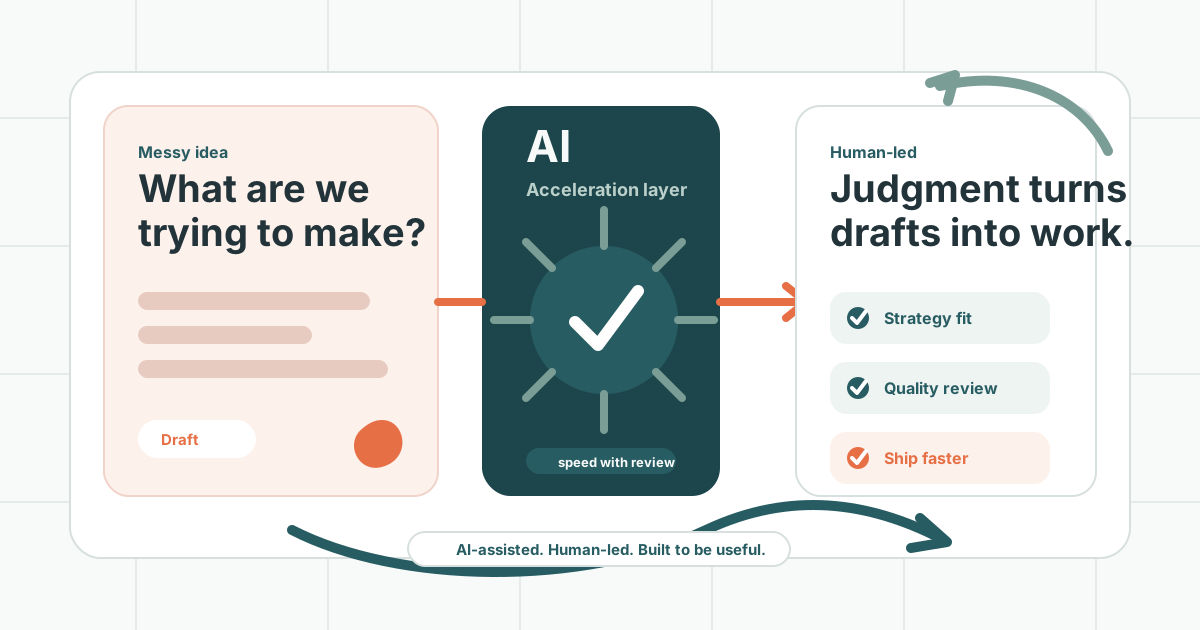
AI is changing how websites and software get built.
That does not mean experienced designers, developers, strategists, and support teams suddenly stop mattering. It means the work can move differently.
The best version of this shift is not “let AI build everything.”
It is:
Use AI to move faster, explore more options, reduce repetitive work, and give experienced people more room to focus on quality.
That is the model we believe in: AI-assisted, human-led.
What AI Changes
Website and software projects have always involved a lot of invisible work.
Before a page or feature is finished, someone has to:
- Understand the business goal
- Sort through rough ideas
- Write requirements
- Compare options
- Draft content
- Explore layout directions
- Build components
- Connect systems
- Test behavior
- Document decisions
- Review details
- Support the project after launch
AI can help with many of those steps.
It can turn a messy idea into a structured outline. It can help draft the first version of a page. It can summarize technical notes. It can generate test cases. It can help inspect code. It can speed up repetitive implementation work.
That acceleration matters.
Faster Does Not Have to Mean Sloppier
Speed has a bad reputation in creative and technical work because rushed work often becomes bad work.
But AI-assisted work is not valuable because it lets teams skip the important parts.
It is valuable because it helps teams get to the important parts sooner.
Instead of spending hours creating a blank first draft, a team can start with a useful structure and refine it. Instead of manually writing every variation of support copy, a team can generate options and choose the one that fits. Instead of slowly exploring one technical approach, a developer can compare several and then make a judgment.
The key is review.
AI can accelerate drafts, research, structure, and implementation. Humans still need to decide what is true, what is useful, what fits the brand, what is secure, and what will actually serve the business.
Where AI Helps Website Projects
For website work, AI can help with:
- Page outlines
- Content drafts
- SEO titles and descriptions
- FAQ development
- Competitive positioning
- Design direction exploration
- Component planning
- Accessibility review prompts
- QA checklists
- Documentation
- Support request intake
That means a small business website can move from idea to first draft much faster.
A service page can be shaped quickly. A blog post can be outlined and edited faster. A landing page can be planned with clearer calls to action. A site map can be explored before design starts.
The result is not that every website becomes generic.
The result should be that more time is spent refining the work around the actual business.
Where AI Helps Software Projects
For custom software, AI can help even more.
A software project often starts with a business owner saying something like:
“We have a spreadsheet that runs everything, and it is getting out of control.”
AI can help turn that messy workflow into clearer requirements:
- Who uses the system?
- What are they trying to do?
- What data matters?
- What steps happen now?
- What should be automated?
- What needs approval?
- What should be reported?
- What should happen first?
From there, AI can help draft user stories, interface ideas, data models, test cases, documentation, and implementation plans.
Developers still make the architectural decisions. They still review the code. They still protect the data. They still decide what should be simple and what deserves a more careful system.
But the project can get organized faster.
How AI Can Save Clients Money
AI does not make work free.
Good work still requires skill, taste, judgment, communication, testing, and accountability.
But AI can reduce the cost of repetitive or early-stage work.
That can save clients money in several ways:
- Faster planning and requirements development
- Faster first drafts of pages and content
- Faster prototyping of layouts and workflows
- Less time spent on repetitive code patterns
- Better documentation without a large documentation budget
- More test coverage and review for the same budget
- Faster support triage and issue summaries
- More efficient small updates
For small businesses, that can make professional website work more affordable.
For growing businesses, it can make custom software projects easier to start.
For enterprise platforms, it can help teams analyze signals, document decisions, and move through complex work with more clarity.
What AI Should Not Replace
AI should not replace accountability.
It should not be trusted blindly with:
- Legal language
- Security decisions
- Privacy commitments
- Client data
- Brand strategy
- Accessibility compliance
- Complex architecture
- Production changes
- Business promises
AI can assist with all of those areas, but a human should still review the output and own the decision.
This matters because AI can sound confident even when it is wrong. It can produce plausible language that misses the business context. It can suggest code that works in a narrow case but creates future maintenance problems.
The tool is powerful. That is exactly why it needs judgment around it.
A Better Client Experience
Used well, AI can make projects feel less slow and mysterious.
Clients can get:
- Faster first drafts
- Clearer requirements
- More options to react to
- Better summaries after meetings
- Faster revisions
- More transparent support tickets
- Better documentation
- Shorter paths from idea to review
That changes the rhythm of a project.
Instead of waiting a long time to see something, clients can respond to useful drafts earlier. Instead of spending a meeting trying to describe everything perfectly, they can start rough and let the team shape the idea with them.
The work becomes more collaborative.
AI in Support and Maintenance
AI is also changing what happens after launch.
Support requests often arrive as fragments:
- “Can we change this section?”
- “Something looks weird on mobile.”
- “Can we add a page for this new service?”
- “The form is not working.”
- “We need a blog post about this topic.”
AI can help turn those fragments into better tickets:
- What page is affected?
- What needs to change?
- Is this a content update, bug, design request, or new feature?
- Is there missing information?
- What should be checked before closing the request?
That helps support teams move faster and helps clients communicate what they need.
Again, the point is not removing people from support. The point is making support clearer and more efficient.
Why Human-Led Still Matters
The businesses we work with do not just need output.
They need decisions.
They need someone to say:
- This platform fits your business.
- This feature can wait.
- This content is too vague.
- This plugin is not worth the risk.
- This page should be faster.
- This design is more polished.
- This integration needs monitoring.
- This claim should be softened.
- This is ready to launch.
AI can assist. It cannot be accountable in the same way a real partner can be accountable.
That is why the best work is AI-assisted and human-led.
What This Means for Small Businesses
For small businesses, AI can make professional web work more accessible.
It can help reduce the time needed to plan, write, build, revise, and support a website. That can lower the barrier to getting a polished site without forcing a large agency budget.
But small businesses should still look for a partner who reviews the work, explains tradeoffs, and provides support after launch.
Cheap output is not the same as a good website.
What This Means for Growing Companies
For growing companies, AI can help teams move from “we need software someday” to “here is the first useful version.”
It can help shape workflows, write requirements, prototype interfaces, and document decisions. That makes custom software less intimidating and easier to phase.
The real value is not building everything at once.
It is building the right thing in the right order.
The Bottom Line
AI is changing the landscape, but not by making quality irrelevant.
It is changing the economics and pace of the work.
Used carefully, AI can help teams deliver better websites and software on accelerated timelines, with less wasted effort and more room for human judgment.
That is the promise:
Faster drafts. Better structure. Clearer support. More efficient implementation. Stronger review.
AI-assisted.
Human-led.
Built for real businesses.